

Process manufacturing has always operated within a delicate balance. Yield variability, material behaviour, formulation complexity, regulatory constraints, and financial sensitivity collectively shape production outcomes. Yet despite decades of system investments, many manufacturers continue to encounter familiar challenges.
The issue, in most cases, is not a lack of data.
It is a lack of precision in how manufacturing reality is modelled, governed, and executed.
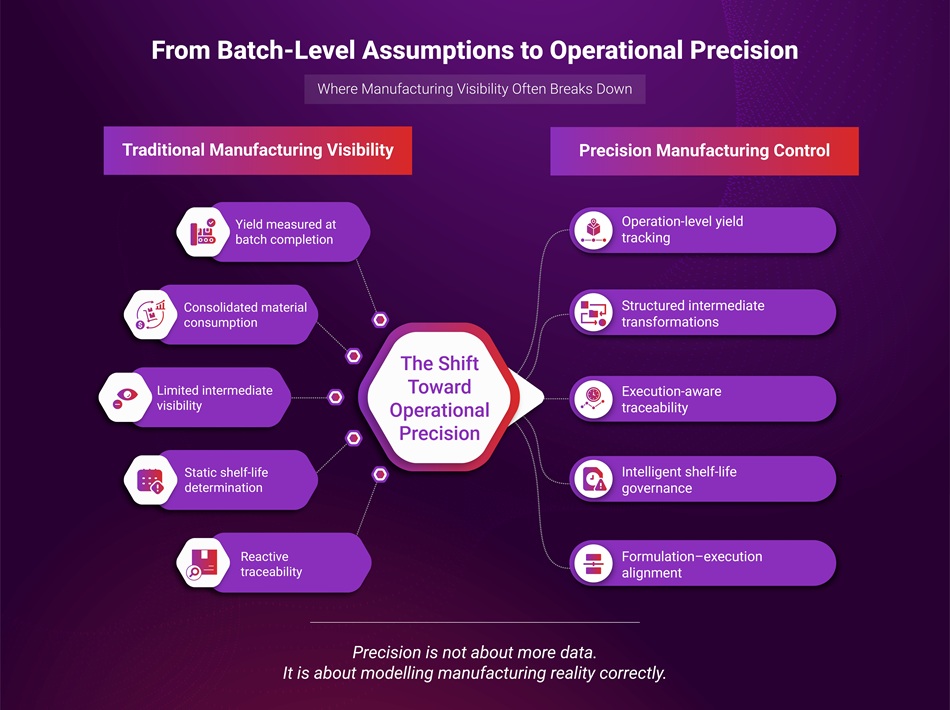
Traditional manufacturing environments often rely on simplified assumptions:
While operationally convenient, these abstractions introduce structural blind spots. Losses occurring within specific operations remain obscured, variances lack contextual clarity, and traceability weakens precisely where regulatory defensibility is most critical.
For organisations operating in margin-sensitive and compliance-driven industries, these gaps directly influence financial accuracy, quality governance, and operational predictability.
Modern process manufacturing is no longer defined solely by throughput. Increasingly, it is defined by:
Predictability, traceability, and decision-quality data.
Manufacturing ecosystems today operate under intensifying pressures:
In this environment, coarse modelling approaches are proving insufficient. Measuring performance only at the batch level often masks where variability originates, where losses occur, and where risk accumulates.
A growing number of manufacturers now recognise that operational excellence requires:
This shift represents more than incremental improvement.
It reflects a redefinition of manufacturing control itself.
Many of the control challenges discussed here reflect long-standing gaps between shop floor execution and enterprise system modelling.
Recent advancements in modern manufacturing platforms — including enhancements introduced across late 25D and 26A release cycles within Oracle Fusion Cloud Process Manufacturing — are specifically addressing these structural limitations. These updates strengthen how formulation, work definitions, yield modelling, batch execution, traceability, and expiry governance remain synchronised throughout the manufacturing lifecycle.
Rather than isolated feature improvements, these changes signal a broader shift toward:
Operation-level precision, execution-aware traceability, and compliance-driven modelling.
This series draws from those advancements to explore how manufacturers can translate evolving system capabilities into practical operational control, improved decision quality, and measurable business outcomes.
For a consolidated analysis of these enhancements and their operational implications, explore the full white paper here.
Precision in process manufacturing is not solely a technology problem. It is shaped by how systems, processes, and governance models interact.
As manufacturing ecosystems grow more complex, many organisations are turning to specialised partners capable of aligning platform capabilities with operational design. Firms such as InspireXT work closely with process manufacturers navigating this transition — helping translate system advancements into measurable operational and business outcomes.
This article marks the beginning of a multi-part series examining the structural control points where process manufacturers either gain precision — or unintentionally lose visibility, predictability, and margin.
Coming next:
Yield — and why batch-level modelling often obscures the true sources of loss and variance.


Request for
services
Find out more about how we can help your organisation navigate its next. Let us know your areas of interest so that we can serve you better.