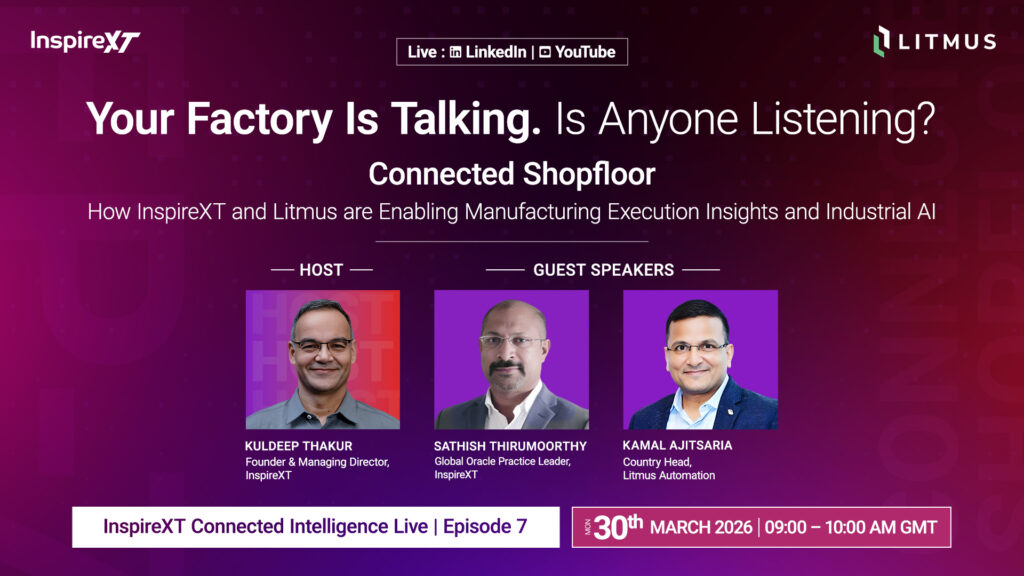
Manufacturers today are not short of data , they are short of timely decisions.
Across factories, machines continuously generate signals about performance, efficiency, quality, and risk. Yet these signals often remain trapped across disconnected systems, making it difficult for organisations to respond quickly.
The gap between shopfloor operations and enterprise systems is where operational value is frequently lost.
In this episode of Connected Intelligence Live, experts from InspireXT and Litmus Automation explore how Connected Shopfloor architecture enables manufacturers to convert machine signals into actionable insights, supporting faster decisions and more responsive operations.
Sathish Thirumoorthy
Global Oracle Practice Leader, InspireXT
Kamal Ajitsaria
Country Head, Litmus Automation
About Connected Shopfloor
Connected Shopfloor is InspireXT’s approach to bridging the gap between shopfloor machines and enterprise systems.
Powered by the Industrial DataOps capabilities of Litmus Automation and the enterprise transformation expertise of InspireXT, the solution enables manufacturers to capture, contextualise, and act on machine signals in real time.
This enables organisations to move from the traditional operating model:
Report → Review → Decide → Act
to a more responsive cycle:
Signal → Decision → Action
Reserve Your Spot
Join industry experts as they explore how connected manufacturing architectures are enabling real-time operational intelligence, faster decisions, and scalable industrial AI adoption.
Manish is an accomplished leader with deep technical expertise and extensive industry knowledge, dedicated to driving transformative change in supply chain management. In his role as Global Solutions Leader, he actively engages with businesses to uncover critical challenges and develops customer-centric, meaningful solutions that address real-world industry needs.