
Connected Operations brings execution into a single flow where plans, machines, workforce, and materials remain aligned, ensuring performance is shaped in real time rather than reconstructed after.
Long before outcomes appear in reports, they begin to take shape in the small, continuous movements of operations, where materials arrive imperfectly, schedules bend under pressure, and decisions must be made without the comfort of completion. This is not a place of design, but of adjustment, where what was planned is constantly being tested against what is possible.
Operations is not held within a single system. It lives across production planning, workforce coordination, machine behaviour, maintenance cycles, and cost control, moving through both process and discrete environments. Each of these carries its own pace, and when they drift apart, even the strongest strategies begin to lose their hold at the point where work is actually done.
In many organisations, this layer exists but does not fully come together. Plans are created with care, data is collected in detail, yet the two do not meet in time. What is missing is not effort, but continuity, the ability for all parts of execution to remain in quiet conversation as work unfolds.
Connected Operations restores this continuity, allowing plans, people, machines, and materials to move together as one flow. It does not remove variability, but brings it into view, so decisions can be taken in the moment they matter, and performance can be shaped as it happens, not understood after.
Disconnected execution layers directly impact throughput, quality, and cost outcomes. Production, machines, workforce, and materials operate without alignment, leading to inefficiencies that compound across the shopfloor.
As scale increases, these breakdowns do not remain isolated. They affect production stability, increase variability, and reduce control over execution outcomes.
Production plans are executed without real-time alignment to machine, workforce, or material conditions, leading to delays and rework.
Machine data, production output, and workforce activity remain fragmented, preventing a clear view of execution health.
Workforce allocation and activity are not aligned with real-time production needs, reducing productivity and increasing idle time.
Machine performance issues are identified late, increasing downtime and disrupting production schedules.
Lack of alignment between process conditions and execution leads to inconsistent quality and higher rejection rates.
Production costs are measured after execution, limiting the ability to control cost drivers in real time.
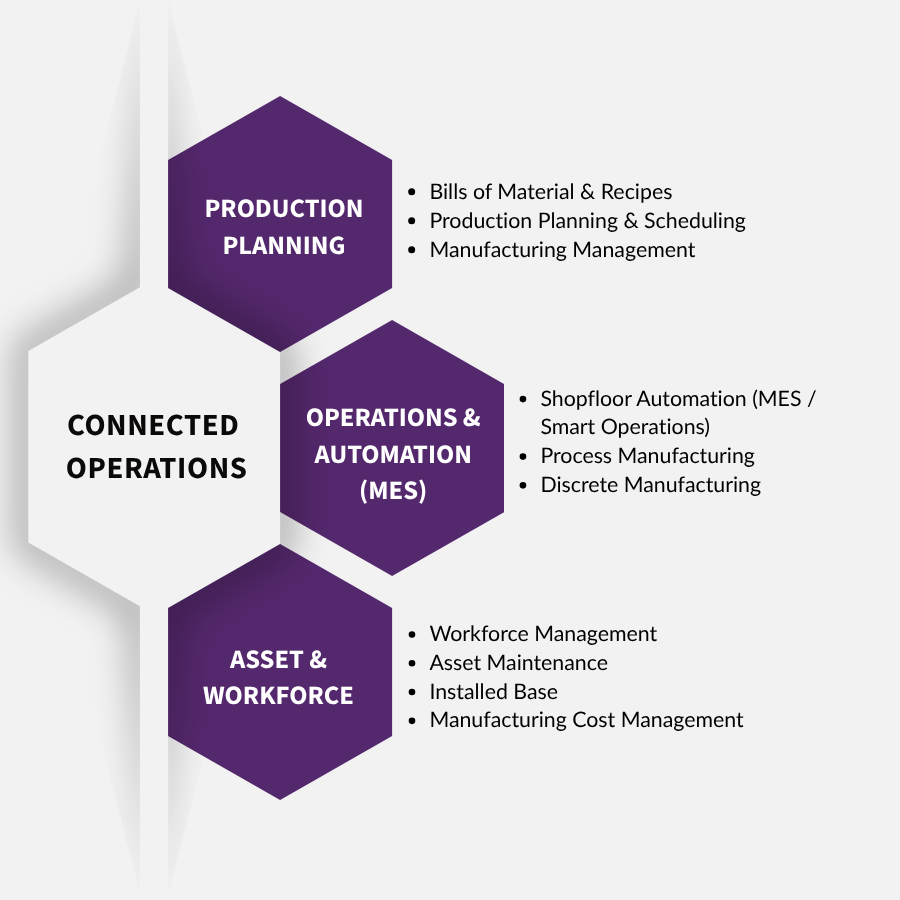
Connected Shopfloor aligns production planning, workforce activity, machine execution, maintenance, and cost into a single, continuous execution flow. Production schedules are not treated as static instructions but are translated into real-time actions, continuously adjusted against machine conditions, workforce availability, and material flow as work unfolds.
This alignment allows each layer to operate on a shared view of production. Machines are no longer monitored in isolation, workforce actions are not coordinated independently of output, and production progress is not assessed after completion. Instead, signals from across execution are brought together, allowing decisions to be taken with an awareness of their immediate and downstream impact.
As a result, execution becomes more stable and predictable. Variations in machine behaviour, material conditions, or workforce capacity are identified earlier, allowing adjustments to be made before they disrupt throughput or quality. Maintenance moves from reactive intervention to informed scheduling, reducing unplanned downtime without interrupting production flow.
Over time, this creates an operating environment where production, machines, workforce, and cost remain in balance. Throughput improves without disproportionate increases in effort, quality becomes more consistent across runs, and decisions are made closer to the point of action, where they can still influence outcomes.