Connected finance aligns financial planning, transaction flows, and reporting into a single, governed operating model—ensuring that financial outcomes remain continuously tied to business activity.
In most organisations, finance operates across multiple systems and process layers that are not fully aligned. Planning, transactions, and reporting are often managed independently, requiring reconciliation to create a coherent financial view.
As the business scales across products, channels, and geographies, this fragmentation becomes more visible. Financial data is consolidated after transactions occur, reporting cycles extend, and decisions rely on information that is not always current or consistent across functions.
Finance today requires alignment across three core elements: planning, execution, and reporting. Financial plans must reflect operational drivers, transactions must be captured within a consistent structure, and reporting must provide an accurate view of performance without reinterpretation.
A connected finance model brings these elements together into a single operating flow. Financial data is structured once, governed consistently, and carried through from planning to reporting—ensuring that finance reflects the business as it operates, not after it is adjusted.
When finance operates on disconnected systems and processes, the impact extends beyond reporting inefficiencies. It directly affects decision-making, working capital control, and the organisation’s ability to respond to change.
Performance is understood only after consolidation, limiting the ability to act on shifts in revenue, cost, or margin.
Effort is concentrated on aligning data across systems rather than analysing performance, increasing cycle times and operational risk.
Different teams operate on different versions of financial data, slowing alignment and reducing confidence in decision-making.
Receivables, payables, inventory, and treasury are not fully aligned, constraining liquidity management.
Budgets and forecasts are updated periodically, without continuous linkage to actual business activity.
Regulatory and statutory reporting relies on manual consolidation across fragmented data sets.
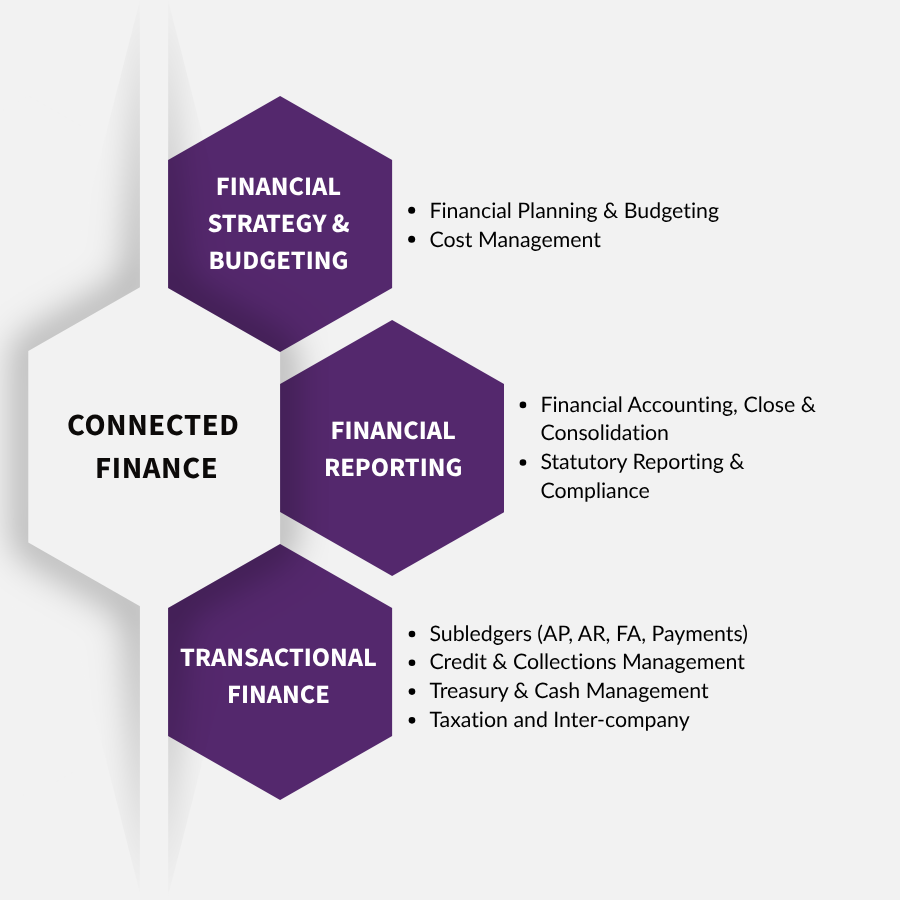
Connected finance brings planning, transaction processing, and reporting into a unified and governed flow, where each financial activity is aligned within a single, consistent framework. Financial plans are structured around key business drivers, allowing them to remain closely connected to operational performance and continuously updated as business conditions evolve. This ensures that planning is not a static exercise, but a dynamic process informed by real-time activity.
Transactions across subledgers, receivables, payables, and treasury are captured within a shared financial model, maintaining consistency in how financial events are recorded and classified. As these transactions flow forward, they integrate seamlessly into close, consolidation, and reporting processes without requiring reinterpretation or manual adjustments at each stage.
Because planning, transactions, and reporting all operate on the same underlying structure, financial outputs remain consistent, traceable, and reliable. This alignment significantly reduces reconciliation efforts, shortens reporting cycles, and improves overall data integrity. The result is a finance function that operates with greater clarity and efficiency, where insights are timely, decisions are better informed, and financial reporting remains continuously aligned with the actual state and performance of the business.