
Connected commerce aligns demand, inventory, and fulfilment into a single operating model, ensuring consistent execution, improved conversion, and control over revenue realisation.
In most organisations, commerce operates across fragmented channels, systems, and teams. Demand is generated across multiple touchpoints, while inventory, pricing, and fulfilment are managed separately—resulting in inconsistent execution across the order lifecycle.
As channel complexity increases, these gaps become harder to manage. Orders are placed without accurate inventory visibility, pricing varies across channels, and fulfilment decisions are made without a unified view of demand and supply.
Commerce performance depends on real-time alignment between demand, inventory, and execution. This cannot be achieved through disconnected systems. A connected commerce model aligns demand, order orchestration, and fulfilment into a single operating flow.
Fragmented commerce operations directly affect revenue conversion and fulfilment outcomes.
Demand is generated without accurate visibility into inventory, pricing is applied inconsistently across channels, and orders are routed without a unified view of supply and execution constraints.
These breakdowns do not remain isolated. As scale increases, they compound across the commerce flow, reducing conversion, increasing cost-to-serve, and limiting control over order execution.
Orders are accepted without accurate inventory visibility, leading to cancellations or delayed fulfilment.
Pricing logic varies across channels, eroding margin control and creating customer confusion.
Orders are routed without full visibility into inventory, location, or fulfilment constraints, increasing cost and delays.
Stock is available but not visible or accessible across channels, leading to lost sales and excess inventory.
Disconnected systems delay order processing, allocation, and dispatch decisions.
Fragmented data prevents a clear view of demand patterns, conversion, and fulfilment effectiveness.
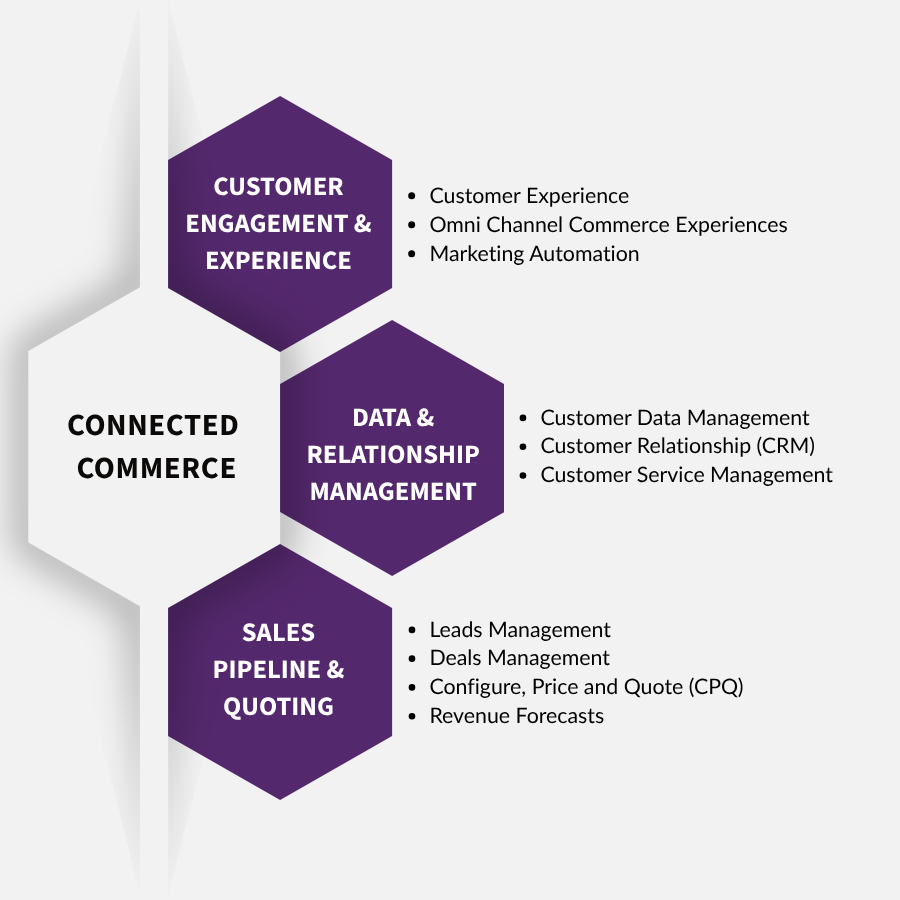
Connected commerce brings demand, order management, and fulfilment together into a unified and continuously synchronized operating flow. Instead of functioning as separate layers, each component works from a shared foundation, ensuring that every signal and decision moves seamlessly across the system. Demand signals generated across multiple channels—whether digital storefronts, marketplaces, or direct sales—are captured and translated into structured, actionable orders without losing context or intent.
These orders are then intelligently orchestrated against real-time inventory visibility, enabling accurate allocation and prioritization based on availability, location, and service commitments. Fulfilment decisions are executed in a coordinated manner, ensuring that the most efficient paths are chosen while maintaining consistency in delivery expectations and customer experience.
At every stage, the system operates on a single, consistent view of product data, pricing, and availability. This eliminates the need for reinterpretation or manual adjustments as orders progress, reducing errors and operational friction. The continuity of data ensures that each function works with clarity and confidence.
The result is a connected commerce model where demand, supply, and execution remain continuously aligned, enabling faster response times, improved efficiency, and a more resilient, scalable approach to modern commerce operations.