Connected supply chain aligns planning, sourcing, manufacturing, and fulfilment into a single operating model, enabling reliable execution, inventory efficiency, and control across the network.
In most organisations, supply chain functions operate across disconnected processes and systems. Planning, sourcing, manufacturing, and distribution are managed separately, with limited alignment across the network.
As demand variability increases and supply networks expand, these gaps become more visible. Plans are created without execution context, supply constraints are not reflected in real time, and fulfilment decisions are made without a unified view of demand and inventory. Supply chain performance depends on continuous alignment between planning, supply, and execution. This cannot be achieved through fragmented systems.
A connected supply chain establishes a common process model that aligns planning, sourcing, manufacturing, and fulfilment into a single coordinated flow.
Fragmented supply chain operations directly affect fulfilment reliability and cost efficiency. Plans are created without execution constraints, inventory is positioned without network visibility, and fulfilment decisions are made without alignment to demand and supply conditions.
At scale, these misalignments compound—reducing service levels, increasing working capital, and limiting control across the supply network.
Plans do not reflect real-time supply constraints, leading to stockouts or excess inventory.
Inventory is available but not optimally positioned, reducing fulfilment efficiency.
Manufacturing and procurement operate without full visibility into demand variability.
Orders are fulfilled without coordinated planning across distribution and logistics.
Excess inventory and inefficient execution increase cost-to-serve.
Fragmented data prevents accurate monitoring and decision-making.
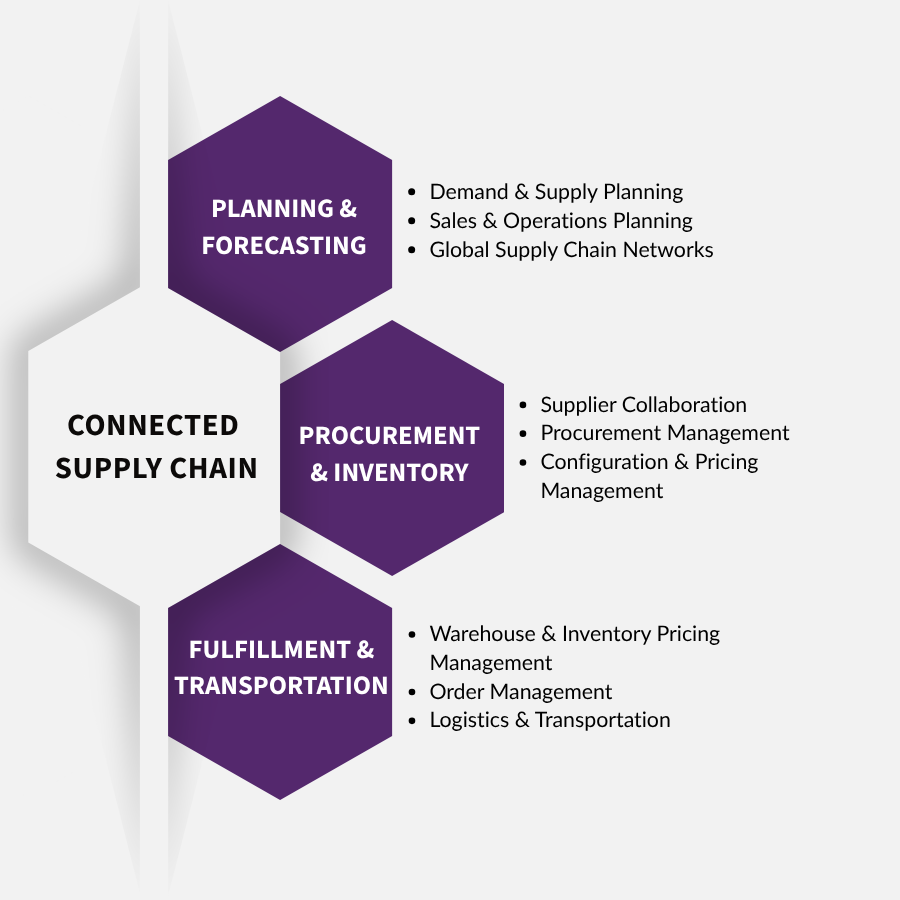
A connected supply chain establishes a unified process model that seamlessly links demand planning, sourcing, manufacturing, and fulfilment across the entire network. Instead of operating in isolation, each function is aligned through a shared structure where demand signals are consistently translated into actionable and coordinated plans. These plans are then executed through synchronized sourcing and production activities, ensuring materials and resources are available at the right time and place.
As execution progresses, fulfilment is driven by optimized inventory positioning and logistics decisions, enabling efficient movement of goods while maintaining service levels. Each stage operates on a consistent and real-time view of demand, inventory, capacity, and network constraints, ensuring that decisions remain aligned and do not require reinterpretation or adjustment as they move across functions.
This continuity reduces inefficiencies, minimizes delays, and eliminates the disconnects that typically arise in fragmented supply chains. The focus is not merely on integrating systems, but on establishing a single, coherent operating model where planning and execution are intrinsically connected. The result is a more agile, transparent, and resilient supply chain that can respond effectively to changing conditions while maintaining alignment across the network.