NaturalAI™ connects process models, delivery methods and operational data into one queryable environment for value chain transformation.
NaturalAI™ is deployed where commercial, operational and functional teams cannot afford to work from different versions of the truth.
Multi-site programmes where process clarity across supply chain and operations determines whether change lands at scale or stalls at the pilot. NaturalAI™ gives every workstream a shared process foundation from day one.
Regulated environments where every process change, design decision & requirement needs complete audit trail. NaturalAI™ turns traceability from a six-week preparation exercise into a live, queryable record.
Fast-moving operations where demand planning, sourcing, fulfilment & finance must stay connected through change. NaturalAI™ keeps process context live across systems as transformation moves at commercial pace.
End-to-end value chains where traceability is a regulatory requirement and where operational performance data must be understood in the context of process. NaturalAI™ connects both.
Processes sit in diagrams. Decisions sit in meeting notes. Requirements sit in trackers. Risks sit in spreadsheets. Operational data sits in systems. That is how transformation slows down.
Process models exist but teams cannot query them, connect them to requirements or trace them into delivery. Documentation becomes overhead rather than the structure the programme runs on.
A 200-person programme team where process knowledge lives in diagrams means every workstream lead rebuilds context from scratch at every phase boundary. The process was documented. Nobody can use it.
What was agreed, why it changed and who approved it becomes impossible to trace six months into delivery. Programmes repeat decisions. Audits become reconstruction exercises.
When an auditor asks why a design decision changed in month four, the answer is six weeks in email archives. The decision existed. The trail did not.
Every phase begins with a team rebuilding context the previous phase already created. Work that should build on itself starts over with each workstream, each new market.
McKinsey puts knowledge workers at 1.8 hours per day searching for information that should already be connected. In a 200-person programme team, that is 45 people spending their entire day finding, not doing.
Databricks and Microsoft Fabric surface what happened. Without a process layer, teams know what happened but not which process caused it or who owns the fix.
The data showed a 12% drop in fulfilment accuracy. Three workstreams claimed it was someone else’s process. Without a connected process layer, nobody could prove otherwise.
Status reporting shows what is moving. It does not show what is at risk, which outcomes are in jeopardy, or where the programme is losing value before it reaches the business.
Bain’s 2024 analysis found 88% of transformations fail to reach their original ambitions. The most consistent reason: the gap between what the status report showed and what was actually at risk.
These are published findings from independent research. Each one measures a different dimension of what fragmented transformation actually costs.
Bain’s 2024 analysis of large-scale change programmes found fewer than 12% reach the outcomes set at the start. The most consistent failure point is the gap between strategy and connected execution.
McKinsey Global Institute’s research on knowledge work. In a 200-person programme team, that is the equivalent of 45 people spending their entire working day looking for information that should already be connected.
Forrester Research found that large organisations average 367 software applications. Each one is a separate place to search. Without a connected process layer, that fragmentation compounds with every tool added to the landscape.
Most transformation programmes fragment across tools, teams and phases because there is no shared structure connecting them. NaturalAI™ provides that structure. It brings together ten years of InspireXT process IP, a repeatable delivery method, AI-augmented automation and natural language query into one connected platform, so organisations can move from fragmented delivery to connected execution.
It is not a wrapper around a foundation model. It is the operating layer your transformation runs on.
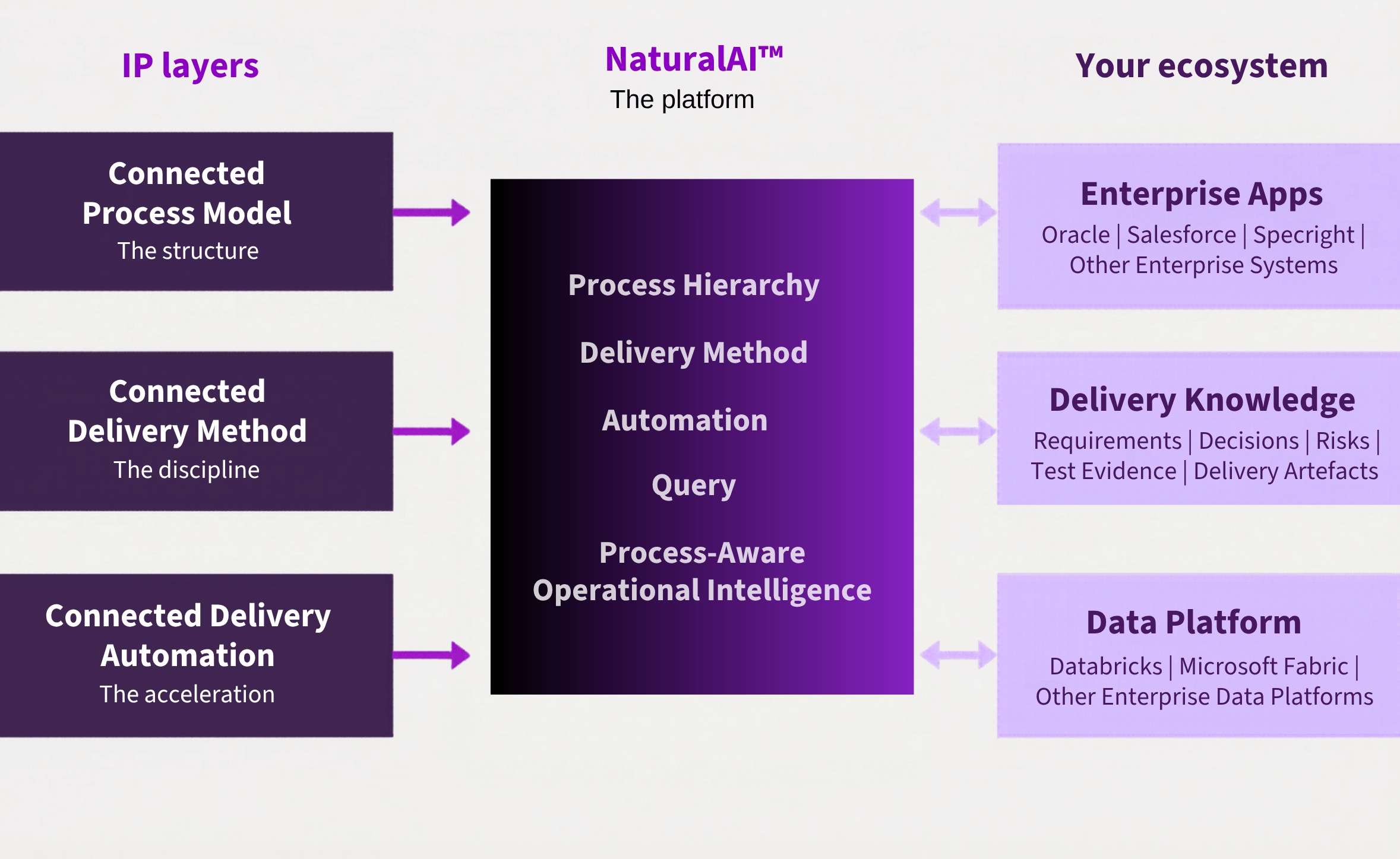
The Connected Delivery Method gives every NaturalAI™ programme a repeatable path from current-state discovery to sustained operational performance. Every phase produces structured outputs the next phase builds from.
Map the current state against the Connected Process Model. Identify process gaps, decision gaps and data gaps. Establish a shared baseline every subsequent phase builds from. Conversational Process Intelligence can be activated on existing artefacts from week one. Typically four to six weeks.
Design the future state with process as the foundation. Requirements, decisions, risks, dependencies and governance are connected to the process they affect. The blueprint is not a document. It is a live, queryable structure every workstream references throughout delivery.
Execute delivery through the Connected Delivery Method. Automation reduces manual artefact effort across design, build and test. Teams work from process context rather than starting from scratch. Enterprise applications such as Oracle and Salesforce connect through NaturalAI™ throughout.
Connect operational data to process context after go-live. Platforms like Databricks and Microsoft Fabric surface performance data. NaturalAI™ adds the process layer that makes that data actionable. Programmes sustain improvement rather than starting the next cycle from nothing.