Disconnected product data and processes create systemic inefficiencies across the lifecycle. A connected product model enables continuity, traceability, and faster execution.
In most organisations, the product lifecycle is managed across fragmented systems, data models, and functions. Design, engineering, supply chain, and compliance each operate with partial ownership of the product, resulting in multiple, inconsistent representations of the same product across the business.
As product complexity increases, driven by regulatory requirements, and portfolio expansion, these inconsistencies become harder to manage. Decisions made upstream are not reliably carried through downstream processes. Data is duplicated, reinterpreted, or lost across handoffs, limiting visibility and control.
This is a structural issue rather than a systems issue.
Products are now expected to be traceable, compliant, and adaptable across their full lifecycle. These requirements are met through
a connected product model that establishes continuity across design, data, and operations, enabling a single, consistent product definition from concept through execution.
Disconnected product data and processes do not remain a technical issue. They surface as operational inefficiencies, compliance gaps, and slower execution across the product lifecycle. As organisations scale product portfolios and regulatory demands increase, these impacts become more frequent, more visible, and more costly to manage.
Inconsistent product data across systems makes it difficult to demonstrate compliance, increasing the risk of audit findings, delays in approvals, and potential penalties.
No single, reliable view of the product exists across its lifecycle, leading to decisions based on partial or outdated information.
Fragmented data across sourcing, formulation, and packaging limits the ability to validate sustainability metrics and respond to regulatory or consumer scrutiny.
Product changes require coordination across multiple systems and teams, increasing cycle times and introducing errors in execution.
Delays in aligning design, data, and operational readiness extend product launch timelines and reduce responsiveness to market demand.
Multiple versions of product data reduce confidence in reporting and decision-making, leading to rework and increased reliance on manual validation.
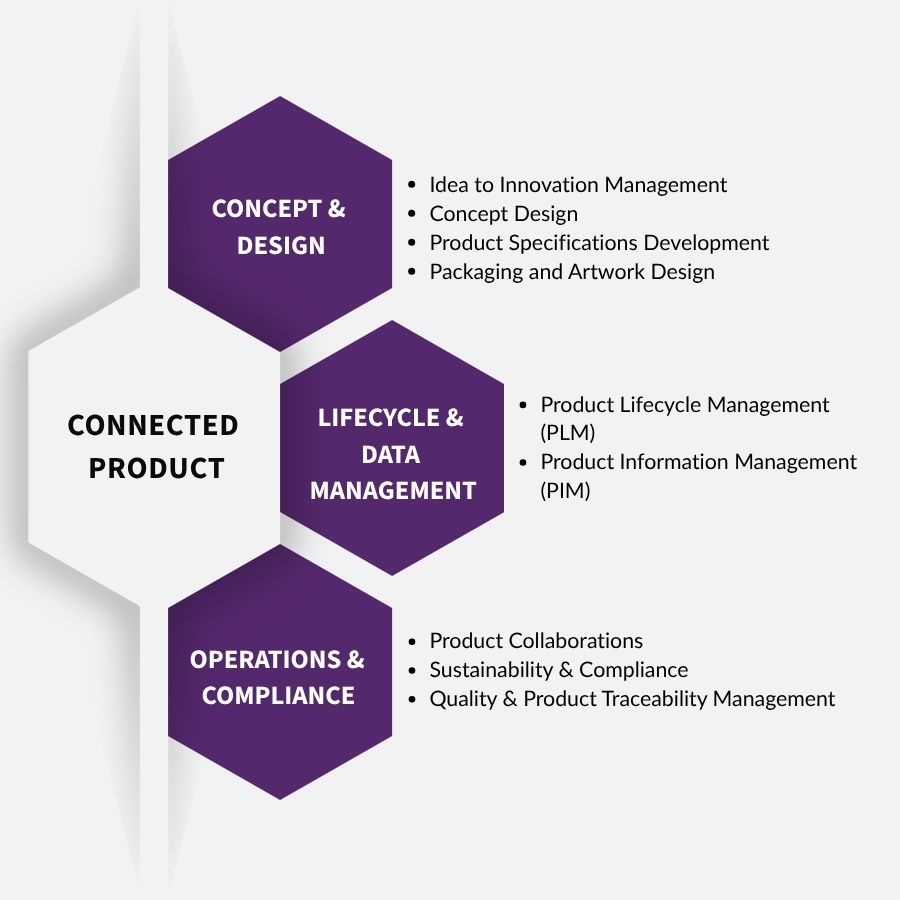
The connected product model brings design, data, and operations into one continuous thread, where what begins as intent in concept and design is gradually shaped into structured product information and carried forward into execution without losing its meaning along the way. Instead of being translated again and again across systems, the product holds its own form as it moves, allowing each function to work from the same foundation rather than rebuilding it at every stage.
As the product evolves, changes, validations, and compliance requirements are carried within this shared definition, so they are managed once and reflected everywhere, quietly reducing duplication and the small frictions that tend to accumulate across disconnected systems. Over time, this creates a steadier rhythm in how work moves, where traceability feels natural because the product carries its own history, and decisions become clearer because context remains intact from start to finish.
What emerges is not just efficiency, but a sense of alignment across the lifecycle, where speed comes from continuity rather than force, and execution feels less like coordination and more like a system that already understands what it is meant to do.