
Humans, machines and agents in food and beverage manufacturing: three imperatives for a connected shopfloor

Key Takeaways HMA is the operating model: HMA means humans, machines and agents working together, and it decides what each one does. It runs on the systems a food and beverage plant already has, and any module can be replaced later. Forward deployed experts find the plant’s know-how, and NaturalAI™ keeps it: InspireXT domain experts work on your plant floor beside supervisors, planners and buyers, from discovery through go-live, because the workarounds that break AI agents are only visible there. NaturalAI™ records every rule, workaround, agent limit and decision against the process it belongs to, and anyone can query it in plain language. Imperative one, expose silent compensation: silent compensation is the manual work people do every shift to make the ERP match the plant. Every food plant runs two supply chains, the one in the ERP and the one buyers and supervisors keep alive with undocumented workarounds. Find and fix those workarounds before any AI agent goes live. Imperative two, take the screen out of execution: on a connected shopfloor, machine signals reach the ERP as work order updates, quality holds and maintenance requests, without a supervisor retyping them. Machines report, agents execute, and people govern the exceptions. Imperative three, make agents act only on live data: under the Fresh Start rule, an agent reads current values from the system of record before every action, and never works from a cached snapshot. What is a connected shopfloor in food and beverage manufacturing? A connected shopfloor is a food and beverage plant where machine data flows straight into the systems that run production, maintenance and quality, so a reading on the line becomes a transaction in the ERP without a person retyping it. Most food plants already collect plenty of machine data. It sits in PLCs, SCADA screens and historians, visible to the engineer on shift and invisible to the planner, the buyer and the quality manager. A connected shopfloor closes that gap in three steps. Step 1: Connect the shopfloor. Machines, PLCs, SCADA systems, sensors and historians are linked through an industrial edge platform. It collects their readings, normalises the formats and adds business context: which line, which batch, which product. A raw temperature value of 4.2 becomes holding tank 3, batch 4471, tomato sauce, within limit. Step 2: Execute the ERP. The contextualised signals feed manufacturing execution, maintenance and quality workflows. A completed fill count becomes a production completion. A vibration threshold breach becomes a maintenance work order. A failed inline check becomes a quality hold with the batch genealogy already attached. Step 3: Scale Connected Intelligence. Once machine data and enterprise data share one governed foundation, the plant can build dashboards, predictive models, AI agents and apps on top of it. This is where the line connects to demand, inventory and planning. NaturalAI™ adds the process context that tells each reading which process it belongs to and who owns it. A plant that skips step 1 builds AI on data nobody trusts. A plant that skips step 2 ends up with excellent dashboards and the same manual transactions. How does the HMA model divide work between humans, machines and agents? The HMA model gives each party the work it does best: machines report physical reality, agents carry out the transactions that follow, and people decide what agents may do. The machine: physical execution and edge data. Sensors, PLCs and edge gateways stream readings every second or faster. They are the plant’s physical record of what is happening on the line. The agent: digital orchestration and execution. Software agents read those signals and run multi-step ERP transactions through APIs, such as an inventory transfer, a revised routing or an adjusted bill of materials. Every action goes into an audit log. The human: governance and exception management. The supervisor stops keying transactions and starts governing. People set the monetary and volume limits, approve changes above a threshold, and take the cases that need judgement, a sensory check or a call to a customer. The rules that connect the three have to live somewhere. In an InspireXT deployment they live in NaturalAI™, tied to the process each one belongs to: which line, which product, which approval limit and which named person signs off. When an agent halts, the halt is recorded against that process, so the team can see which workaround caused it and who owns the fix. HMA does not depend on any one vendor. Underneath it sits a headless architecture: the ERP keeps all of its business logic, but its screens stop being the only way in. For a food and beverage producer the practical test is one question. Can every action a supervisor takes on a screen also be taken through an API? The platforms underneath can change. What has to stay constant is the knowledge of how the plant actually runs. That is why InspireXT works forward deployed, on NaturalAI™: engineers on the floor find that knowledge, and NaturalAI™ keeps it. What changes Before HMA After HMA How transactions happen People key them into ERP and MES screens Agents call ERP and MES APIs Time from event to record Minutes to a full shift Seconds Workarounds Made by hand and never recorded Surfaced as exceptions and logged against the process Role of AI Copilot summarises and suggests Agent executes within set limits Software model One suite, upgraded as a block Composable modules, replaced one at a time How does InspireXT deliver a connected shopfloor? InspireXT delivers a connected shopfloor with forward deployed domain experts who work on the client’s plant floor, using NaturalAI™ as the base for everything they build. Forward deployed: domain experts on your plant floor Forward deployed means our domain experts work inside your operation, beside your supervisors, planners and buyers, and build with them. They do not design from a distance and hand over a solution. This matters for one reason. The workarounds that break AI agents are only visible on the floor. An engineer standing at the filler on line
Oracle EPM in 2026: Why CFOs are forcing operations and finance to share one brain

Key Takeaways The spreadsheet era is officially a liability. The Gartner official research on Financial Planning and Analysis confirms that Extended Planning and Analysis (xP&A) is no longer optional. Enterprises failing to connect operational drivers to financial outcomes face a measurable agility deficit. True agility requires architectural overlap. The value of Oracle Enterprise Performance Management (EPM) Cloud is not just migrating data to cloud servers. It requires deploying Planning, Consolidation (FCCS), Account Reconciliation (ARCS), Costing, and Reporting modules so tightly interlocked that data moves through them without human translation. Siloed planning drains enterprise value. Operations running disconnected from finance creates a heavy drag on overall efficiency. Insights from the Forrester Enterprise Architecture research blog emphasize that cohesive, outcome-driven investment strategies are required to maintain competitive margins in highly volatile markets. Asset-heavy industries have the most to gain. Manufacturing, Pharma, and Food & Beverage are the primary proving grounds for this technology. A detailed McKinsey analysis on Enterprise Performance Management highlights that navigating a volatile macroeconomic environment requires deep integration between real-time operational data and financial models to prevent severe margin erosion. Narrative Reporting changes the audit game. By layering Oracle Narrative Reporting directly on top of Financial Consolidation and Close, companies eliminate the manual reconciliation of board decks and statutory filings. This entirely removes the risk of copy and paste errors. Why Do CFOs Struggle with 30-Day Financial Reporting Lags? Chief Financial Officers struggle with 30-day reporting lags because operational data and financial data live in disconnected systems. Furthermore, controllers spend weeks manually matching thousands of transactions in spreadsheets rather than utilizing automated reconciliation, causing massive delays in scenario modeling and margin visibility. A recent shift in enterprise volatility has exposed a glaring weak point across the corporate landscape. Companies have spent the last decade modernizing their core Enterprise Resource Planning (ERP) and Product Lifecycle Management (PLM) systems. This modernization generates terabytes of high-quality operational data every single day. Yet, when it comes to the actual financial planning and the month-end close that drives the business forward, the majority of that work is still exported into disconnected offline models. That disconnect has a real cost, and it is highly measurable. When a supply chain team adjusts inventory forecasts based on sudden raw material shortages, finance often does not see the margin impact until the end of the month close process. The delay is compounded by accounting teams manually reconciling bank feeds against sub-ledgers. Two teams working off two entirely different versions of the future is exactly how strategic agility disappears. A CFO who used to get judged mainly on the accuracy of historical reporting is now being judged on whether the business can actively model its future. As outlined in the Deloitte perspective on the Future of Financial Planning and Analysis, finance transformation is shifting from analyzing past performance to actively shaping the future through rapid scenario modeling. When the operational systems, the reconciliation tools, and the planning systems do not share one unified logic, somebody in the middle reconciles them by hand. That manual patch creates a 30-day reporting lag. This is a delay that modern enterprises simply cannot afford. What is the Architecture of Overlap in Oracle EPM Cloud? The architecture of overlap in Oracle EPM Cloud refers to deploying distinct financial modules, such as Planning, FCCS, ARCS, and Narrative Reporting, on a single unified data model. This eliminates manual data transfers, ensuring that operational updates instantly trigger financial recalculations across the entire enterprise. The true Return on Investment of Oracle EPM Cloud is not just that it sits on scalable infrastructure or reduces on-premise server costs. It is that its individual modules are designed to completely overlap. This creates a closed-loop system where data flows seamlessly from operational input to final regulatory output. When correctly architected, there is no daylight between these five core engines. We call this the Oracle EPM Module Matrix. Oracle Enterprise Planning (The Forward View): This is where xP&A lives. It ingests operational drivers directly. When the supply chain alters procurement volumes or shifts a manufacturing routing, this module instantly calculates the forward-looking financial impact. It allows businesses to run complex what-if scenarios in minutes. For example, if a company wants to model the impact of a ten percent tariff increase on raw materials, the Planning module will automatically adjust the cost of goods sold across the entire product portfolio. Oracle Profitability and Cost Management (The Margin Engine): Blunt, top-down cost allocations no longer work in a complex global market. This module traces exact overhead costs, including freight, warehouse space, utility usage, and machine hours, down to a specific customer or product SKU. By abandoning the peanut butter approach to generic cost allocation, businesses can identify their truly profitable products and their hidden loss leaders. It pushes those refined profitability metrics back into Planning to inform future pricing strategies. Oracle Account Reconciliation (ARCS – The Data Cleanser): The silent killer of financial agility is the manual reconciliation of balance sheet accounts. ARCS sits directly beneath the consolidation process, automating high-volume transaction matching across bank feeds, sub-ledgers, and corporate systems. When ARCS flags an exception, it workflows the issue directly to the right analyst with rule-based auto-match capabilities. Without ARCS cleaning and certifying the data, consolidation stalls, and planning models run on inaccurate actuals. Oracle Financial Consolidation and Close (FCCS – The Anchor): This engine handles the complex global reality of enterprise accounting. FCCS covers multi-GAAP reporting requirements, multi-currency translations, and automated intercompany eliminations. FCCS automates the mechanical heavy lifting of the month-end close so controllers can focus on strategic variance analysis rather than data entry. Crucially, certified actuals from FCCS instantly feed back into the Planning module to recalibrate the rolling forecast automatically. This creates a perfect loop between historical truth and future projections. Oracle Narrative Reporting (The Output): A board of directors needs the story behind the numbers rather than just a spreadsheet. This module sits directly on top of the other four. It blends structured financial data with unstructured commentary, ensuring
Microsoft Fabric and Databricks: why CIOs don’t have to choose in 2026

Key Takeaways Only 1 in 20 large companies say their data is actually ready to support their AI initiatives, according to a 2026 Dun & Bradstreet survey. Microsoft Fabric and Azure Databricks can now read each other’s data in both directions without copying it, a capability that reached general availability at Databricks‘ Data + AI Summit in June 2026. Running both platforms together lowers cost and speeds up reporting by removing duplicate copies of the same data, and it closes a real gap: 78% of executives don’t feel confident they could pass an independent AI governance audit today. Mastercard, Novo Nordisk, and PepsiCo are among the named companies already building on this exact combination. The decision left for CIOs is where the next budget dollar goes: deeper into Databricks engineering, or deeper into Microsoft Fabric and Power BI reporting. Every board is asking the same question this year: are we ready for AI. Most CIOs already know their honest answer, and it comes as a number, not a feeling. Nearly every large company already has AI initiatives running. Only 1 in 20 believe their own data can actually support that work. That gap has a boring, specific cause: the numbers a data science team trusts and the numbers a board sees have rarely been the same copy. For any enterprise already running both Microsoft Fabric and Databricks, that copy problem closed this summer. What’s left now is a budget question: where the next dollar of data investment goes. Why only 1 in 20 companies say their data is ready for AI A recent survey from Dun & Bradstreet found that 97% of large organizations already have active AI initiatives running. Only 5%, about 1 in 20, say their data is actually ready to support that work. Cayetano Gea-Carrasco, the firm’s chief strategy officer, drew the real distinction: a company doesn’t need its entire data estate to launch a pilot or a single AI use case. It needs that discipline to run AI reliably across the workflows that keep the business moving, onboarding, compliance, risk management, customer operations. That’s a much higher bar, and it’s the one 95% of large companies haven’t cleared yet. That has a real cost, and it’s measurable. Grant Thornton’s 2026 AI Impact Survey found that 78% of executives don’t feel confident they could pass an independent AI governance audit with ninety days’ notice. Two teams keeping two versions of the same number is exactly how that confidence disappears. A separate IBM Institute for Business Value study found that two out of three CIOs and CTOs are already being held accountable for AI systems they don’t fully control. The accountability showed up before the tooling to manage it did, and that’s exactly where a CIO’s own job gets harder, whatever the board deck says about strategy. None of this is really new pressure, just louder pressure. Deloitte’s 2026 Global Leadership Technology Study found that 79% of IT leaders now list driving business outcomes, not keeping systems running, as their top priority. A CIO who used to get judged mainly on uptime is now getting judged on whether the business actually trusts what comes out of the data underneath it. That’s a harder thing to be graded on, and it’s exactly the grade the readiness numbers above are describing. For a large group of companies, this gap has a specific, familiar shape. Databricks tends to be where a data science or engineering team does its real work, training models, cleaning up messy source data, building pipelines. Microsoft Fabric, and Power BI running inside it, tends to be where the rest of the business actually sees those numbers, in dashboards, in board decks, in reports a CFO signs off on. When the two systems don’t share one copy of the data, somebody in the middle reconciles them by hand, and that manual patch is exactly the pattern Kupriyanova describes. That’s the version of the AI-readiness problem worth solving first, because as of this year, it has an actual fix behind it. The ROI case for running Microsoft Fabric and Databricks together Microsoft Fabric has been able to read data governed inside Azure Databricks for a while now, without copying anything. This June, the reverse became true too: Azure Databricks can now read data sitting in Microsoft Fabric’s OneLake, a capability that reached general availability at Databricks’ own Data + AI Summit rather than staying a preview. That’s the plumbing. What it’s actually worth is a different question, and answering it honestly means netting the benefit against what it still takes to get there, not just listing the upside. For a company already running both platforms: Lower infrastructure cost, but only once both directions are actually configured and adopted, not automatically the day the announcement lands. The direction where Azure Databricks writes its own tables into OneLake is still in public beta, so full symmetry isn’t universal yet. Faster reporting, but only as good as the data underneath it. Zero-copy access moves a bad number to a board just as fast as a good one. This removes a delay. It doesn’t fix a data-quality problem. Lower audit exposure, but governance still has to be set up on both sides. One shared copy of the data doesn’t mean one shared set of permissions around it. Somebody still has to decide who can see what, on each platform, deliberately. For a company that only runs one of the two today and is deciding whether to add the other: The cost of adding the second platform drops, since doing so no longer means re-architecting the first one or building a custom pipeline just to connect them. The switching risk drops too. Adding Microsoft Fabric doesn’t require pulling data science workloads off Databricks, and adding Databricks doesn’t require giving up Power BI reporting already built on Microsoft Fabric. The timeline drops, from months of custom integration work to whatever it takes to turn on a feature that already exists. None of this is
Lease Accounting Under IFRS 16: Moving from Spreadsheet Control to Oracle Fusion Execution

Lease accounting requires organisations to recognise Leased Assets and Lease Liabilities on the balance sheet for most of the lease arrangements
The Active ERP: How Agentic AI Accelerates Oracle Supply Chain Operations
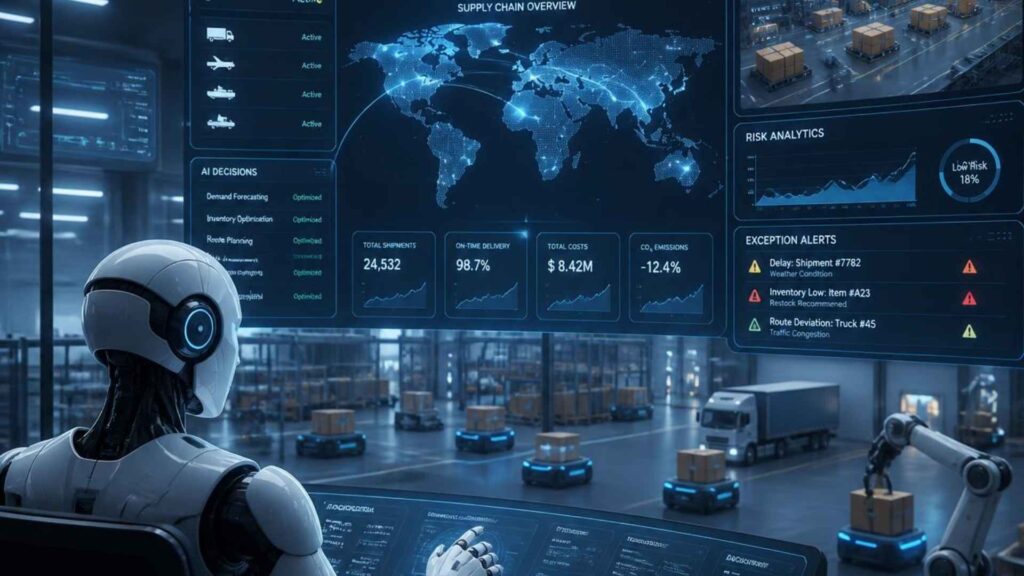
Key Takeaways The Copilot Bottleneck: Conversational AI only summarizes data. Supply chains still rely on human operators to manually execute the actual transactions, leaving operational speed completely unchanged. The Risk of Automated Chaos: Deploying autonomous AI against degraded master data does not create efficiency. It executes flawed logic at an uncontrollable, systemic scale. Gartner ties this directly to data hygiene, and McKinsey’s own research finds that most organizations see no measurable AI return precisely because of weak data and governance foundations, not the technology itself. The End of Silent Compensation: Planners and buyers constantly, manually correct bad ERP data to keep orders moving. Autonomous agents expose this hidden “data debt” because they enforce policy literally. Outcome-Driven Execution: Deploying specialized digital workers, such as Buyer’s Navigator and Smart Yield, shifts the business from reactive firefighting to proactive, automated execution and absolute compliance. Enterprise leaders are currently caught in a costly AI trap. The market has sold them on the promise of autonomous, self-healing supply chains, but what many have actually purchased and deployed are conversational copilots. Gartner has begun warning against exactly this substitution, cautioning enterprises about vendors rebranding legacy automation as agentic AI, when true agentic AI requires goal-oriented reasoning, cross-application orchestration, and persistence that simple automation scripts do not have. The transition from passive software systems to active, autonomous execution is not merely a version upgrade. It represents a fundamental shift in the physics of enterprise operations. Oracle’s recent deployment of Agentic AI provides the robust architectural foundation required for this shift, moving the enterprise away from static ledgers. However, unlocking this capability requires a complete re-evaluation of how a business engineers its operational workflows. Transitioning from a passive ERP to an active, executing ecosystem exposes massive, hidden business risks that leaders must mitigate before they automate. Why are conversational copilots failing to accelerate supply chain operations? To understand why the enterprise is hitting the structural ceiling of current AI models, we must separate the concept of intelligence from the concept of execution. First-generation generative AI in the enterprise took the form of the copilot. These tools are highly sophisticated summarization engines. They can read a fifty-page vendor contract, flag a delayed inbound shipment, or draft a standardized email to a supplier. However, they remain fundamentally passive. They operate on a strict human-in-the-loop design paradigm. The AI observes the data, interprets the anomaly, and advises a course of action, but it waits for a human operator to execute the actual transaction. Consider a sudden, localized demand spike that threatens to stock out a regional distribution center. A conversational copilot might alert the demand planner to the anomaly hours or days faster than a traditional reporting dashboard. Yet the demand planner remains the ultimate operational bottleneck. They must still manually swivel across multiple Oracle Fusion screens, manually recalculate the material requirements, override the system’s static lead times based on their own institutional knowledge of logistics bottlenecks, and manually execute the purchase order adjustments or inventory transfers. The copilot did not solve the systemic friction. It merely reported on it faster. The business is still paying for human execution, and the speed of the supply chain remains limited by the speed at which an operator can type and click through a user interface. True acceleration requires removing the human from the micro-transaction entirely. What is the hidden cost of silent compensation in enterprise master data? Most complex, global organizations are secretly running two completely different supply chains simultaneously. There is the digital supply chain residing in the Oracle ERP, defined by static lead times, rigid master data, strictly enforced bills of materials, and predefined capacity constraints. Then there is the physical supply chain that human operators manage in reality. Every single day, buyers, demand planners, and floor supervisors perform an act of silent compensation. The master data in the ERP might state that a specific supplier in Southeast Asia has a fourteen-day lead time. However, the veteran buyer knows that during the monsoon season, port congestion always pushes that lead time to twenty-one days. To ensure the factory does not run out of raw materials, the buyer manually pads the purchase order date. In another department, a hardware engineer knows a legacy component in a bill of materials is technically flagged as obsolete in the system, but they know it is physically viable for one last production run, so they manually override the system flag to keep the line moving. These human operators keep the business running, but their manual workarounds create zero permanent systemic record. Because the buyer manually intervened, the material requirements planning engine still believes the lead time is fourteen days. It will continue to generate flawed procurement recommendations for every subsequent order. The gap between operational reality and the digital system of record grows wider every shift. The business becomes entirely dependent on the undocumented memory of its employees rather than the logic of its ERP. Book a 30-minute Agentic Readiness Audit and see exactly where your Oracle data breaks down before an AI agent finds out for you. Book the session How does raw AI automation threaten the stability of Oracle Fusion ERP? If you remove the human compensator and hand the operational keys to an autonomous AI agent, you trigger an immediate systemic crisis. An autonomous agent operates human-on-the-loop. It does not just summarize, it executes multi-step workflows. It is given an objective, such as rebalancing inventory to prevent a stockout, and it breaks that objective down into discrete tasks, navigating the system to achieve the goal.However, an AI algorithm does not possess a veteran buyer’s undocumented institutional knowledge. It does not know which system values to distrust. It takes the degraded master data literally. If you unleash an agent on an uncalibrated supply chain, it does not increase efficiency. It automates systemic chaos, authorizing bad spend based on outdated compliance files, routing critical orders based on flawed lead times, and causing stockouts at a scale and speed humans cannot catch or manually reverse.
Why AI in pharma planning finds problems before it solves them

Key Takeaways AI in pharma and life sciences planning exposes data problems before it solves planning problems. That distinction changes what an implementation is worth. Pharmaceutical manufacturers run two planning systems simultaneously: the ERP and the planner’s institutional knowledge. Only one is visible to the business. When AI removes the planner’s silent corrections, constraint violations emerge. These are not system failures. They are the first accurate map of where the product master has drifted from operational reality. At Colorcon, more than 20% of product records carried incorrect planning attributes corrected manually for years. Once fixed, 70% of planning tasks were automated. InspireXT’s Data and AI Practice, built with Databricks, extends this diagnostic from a single site to the full enterprise data estate. Pharma planning runs on two systems. Only one is in the ERP. Every pharmaceutical manufacturer of meaningful scale has a planning system, usually an ERP such as Oracle or SAP, or something older and heavily customised. The system holds the master data: product specifications, batch sizes, resource capacities, customer orders, and ship dates. Alongside that system, there is the planner. The planner holds a second planning system entirely, built from years of running the same process across hundreds of production cycles. They know which product records have drifted from how the product actually behaves on the floor. They know which blender or reactor handles which formulation, not because the system says so, but because they learned it from experience. They know which orders can be consolidated without violating quality parameters, which cleaning sequences cannot flex, which customer has a hard ship window that leaves no room for a schedule adjustment.This second system is the real planning system. The ERP is the starting point. The problem is that the second system is invisible to the business. It lives in one or two people’s heads and is never formally documented. It does not appear on any dashboard or audit report. Because the schedule holds week after week, there is no visible signal that the ERP alone could not have produced it. Deloitte’s 2025 Smart Manufacturing Survey found that 46% of manufacturers report significant challenges filling planning and scheduling roles. The talent pressure is real, but it is a symptom of a structural condition: when planning capability lives in people rather than systems, every departure carries an operational risk the business absorbs silently, without ever connecting it to the data underneath. Why the gap between the ERP and the planner is structurally invisible The invisibility of this gap is produced by the manual process itself. When a planner adjusts a batch size because they know the system value is wrong, that adjustment creates no record anywhere in the operation. There is no exception log, no flag in the ERP, no documented reason for the change. The schedule looks like it came from the system. The customer ships on time. The Head of Supply Chain sees a clean dashboard and draws the reasonable conclusion that the planning process is working well. What the Head of Supply Chain does not see is that the planner corrected seventeen product records this week, that three of them carry bulk density values the ERP has held incorrectly since a supplier specification changed eighteen months ago, and that if a different person had built the schedule using the system values literally, two of this week’s batches would have been sized incorrectly and one would have violated a GMP cleaning sequence before the error was caught. This is the structural condition in most pharma planning operations today. The system looks accurate because a person is constantly correcting it without leaving a trace. CDER warning letters rose 50% in FY2025, with more than a third citing GMP violations traced to documentation failures, specifically gaps between what the system recorded and what happened on the floor. Many of those failures had the same origin as the condition described above: a manual workaround that worked reliably until it did not, and left no documentation to show it had been running in the first place. The gap remains invisible until automation arrives, at which point it becomes the most visible thing in the operation. What AI actually does when it runs against pharma planning data for the first time The AI planning algorithm does not think. It does not compensate or apply judgement built from years of experience. It takes what the system holds and runs the optimisation against those values literally, without adjustment, and without the institutional knowledge that tells a planner which values not to trust. When a bulk density value is wrong in the Oracle product master, the algorithm uses the wrong value. It calculates a batch size based on that value, and if the calculated batch size exceeds the blender’s validated working capacity, the system produces a constraint violation. It flags the output and halts rather than routing around the problem the way the planner would have. To an implementation team seeing this for the first time, the constraint violations can look like system failures. In the first week of go-live, when violations flag across multiple product records simultaneously, the instinct is to look for bugs in the configuration. The bugs are not in the configuration. They are in the data, and every constraint violation is a precise record of exactly where the system value and operational reality have diverged. The algorithm is not finding planning errors. It is finding data errors that the planning process had been absorbing silently at the cost of the planner’s time and expertise, for years. This is what makes AI a diagnostic tool before it is an automation tool. Its inability to compensate, the very thing that makes an implementation feel like it is failing at first, is precisely what makes the data problem visible for the first time. The constraint violations were not failures. They were a map. Once an implementation team understands what the constraint violations represent, the output changes completely in meaning. Each flagged exception is not a broken output
Why 95% of enterprise AI pilots fail to reach production, and what the 5% build first

Key Takeaways MIT’s GenAI Divide study, built on 150 executive interviews, 350 employee surveys, and 300 analysed deployments, found that 95% of enterprise generative AI pilots delivered no measurable P&L impact across an estimated $30 to 40 billion of investment. The lead author traced the failure to enterprise integration, with model quality rarely the constraint. Gartner predicts that through 2026, organisations will abandon 60% of AI projects unsupported by AI-ready data. In its survey of 248 data management leaders, 63% said they either lack, or are unsure they have, the data management practices AI requires. McKinsey’s State of AI research shows adoption is no longer the question: 88% of organisations use AI in at least one function, yet only around a third have begun to scale it, and just 7% report AI fully scaled across the enterprise. AI is a multiplier. It amplifies whatever the data already contains. On a governed ecosystem it amplifies analytical advantage. On a fragmented one it amplifies errors, faster than humans can catch them. Architecture sets the ceiling on intelligence. AI confined to one system answers narrow questions. AI running on unified commercial and operational data answers a different category of question entirely, and that gap compounds over time. The pilot that impressed the board and then disappeared Ask a senior executive at any mid-to-large enterprise whether the organisation is investing in AI, and the answer is yes. The pilot has run. The proof of concept landed well in a boardroom presentation. The vendor roadshows have been attended. The AI strategy document exists. Twelve months later, the pilot has not become a production system. The business outcomes remain theoretical. The board is asking, again, why the spend has not turned into impact. The narrative that usually accompanies this moment blames the technology. The models are immature. The use cases were too ambitious. The organisation moved too fast, or its industry is uniquely complex. This narrative is comfortable, widely repeated, and wrong, and it is damaging because it points investment away from the actual cause of failure. The models that data scientists build in a proof of concept are genuinely capable. The demos land. The accuracy metrics are real. The failure happens when those models meet the organisation’s actual data ecosystem: production data that is fragmented, inconsistently labelled, and governed by no one; workflows that were never redesigned to act on the model’s output; and no infrastructure to monitor the model once it is live. The bottleneck is never the model. It is always the foundation underneath it. What the research actually shows The failure rate of enterprise AI stopped being anecdotal in 2025, when three independent research efforts converged on the same conclusion from three different directions. The MIT NANDA initiative’s GenAI Divide: State of AI in Business 2025, covered in depth by Fortune, found that 95% of enterprise generative AI pilots delivered no measurable P&L impact, across $30 to 40 billion of estimated investment. Lead author Aditya Challapally was specific about the cause: executives tend to blame regulation or model performance, but the research points to flawed enterprise integration, a learning gap in which tools never adapt to actual workflows and organisations never adapt their workflows to the tools. Two of the study’s secondary findings deserve more attention than they get. Budgets concentrate in sales and marketing pilots, where measured returns are lowest. And organisations that bought from specialised vendors and built partnerships reached deployment around 67% of the time, while purely internal builds succeeded roughly a third as often, a finding that says experienced delivery patterns beat in-house enthusiasm. Gartner reached the same destination from the data side. Its February 2025 analysis predicts that through 2026, organisations will abandon 60% of AI projects unsupported by AI-ready data. The supporting survey of 248 data management leaders found that 63% either lack, or are unsure they have, the data management practices AI requires. Gartner’s warning is structural: organisations that treat AI data requirements as an extension of traditional, report-oriented data management endanger their entire AI effort. McKinsey’s State of AI research completes the picture from the adoption side. Based on 1,993 respondents across 105 countries, it found that 88% of organisations now use AI in at least one business function, up from 78% a year earlier. Yet most remain in experimentation or piloting, only around a third have begun to scale, and just 7% report AI fully scaled across the enterprise. Usage is everywhere. Value at scale is rare, and McKinsey’s own conclusion points to workflow redesign as the missing ingredient. Three research houses, three methodologies, one finding. The constraint sits beneath the model, in the data and the operating model around it. Three ways enterprise AI dies between pilot and production Across manufacturing, pharmaceutical, and supply chain enterprises, the same three failure modes recur, and naming them precisely matters because each one demands a different fix. Data quality and governance failure. The pilot model was trained on a hand-curated dataset that does not resemble the messiness of production. Deployed against real data, accuracy degrades, and there is no systematic process for resolving the quality issues because governance was never established as part of the programme. In regulated industries such as pharmaceuticals, this goes beyond accuracy: ungoverned AI inputs and outputs are a compliance exposure that can halt a programme entirely. Operationalisation failure. The model produces an output and the organisation has no mechanism for acting on it. A demand forecasting model whose recommendation a planner must manually review, re-enter, and override in a separate system has automated nothing. It has added a step to an already complex process, and the AI sits technically live and practically unused. This is MIT’s learning gap made concrete: the tool never entered the workflow where the decision actually happens. MLOps absence. The model performs at deployment and degrades as the underlying data distribution shifts. With no automated monitoring, no drift detection, and no retraining pipeline, the degradation goes undetected until the business notices the recommendations have become
Pharma manufacturing’s planning problem: what automation exposes that nobody expected

Key Takeaways Pharma planning looks like a supply chain problem. It is a data problem, and that distinction only becomes visible when you try to automate. In made-to-order pharma manufacturing, every customer order is a unique production event. There is no inventory buffer to absorb a planning error. The schedule is the commitment. McKinsey’s pharma operations benchmarking shows top-quartile manufacturers reach final delivery in half the time of average manufacturers, and more than five times faster than bottom-quartile ones. The difference traces to planning frequency and process standardisation, not capacity investment. When automation arrives, it does not just replace manual work. It exposes what the manual process was hiding: data quality problems, undocumented process logic, and system dependencies that nobody had formally mapped. The fear that a legacy system cannot coexist with a modern planning layer is the most expensive assumption in pharma operations. It is also, in most cases, wrong. The planning problem nobody has formally named Every week, inside pharmaceutical manufacturing and ingredient businesses across the US and UK, the same sequence of events plays out. A planner arrives on Monday morning and opens a spreadsheet. On one side: every open customer order, each with a specific product, quantity, and ship date. On the other: the available production resources, blenders, lines, batches, raw materials, spread across one site or several. The planner’s job is to make those two things meet, for every order, by Wednesday. No system does this automatically. The planner does it through a combination of experience, institutional knowledge, and manual reconciliation that has accumulated over years. They know which blender handles which formulation. They know which orders can be consolidated into a single batch without violating quality parameters. They know that a last-minute order change on Tuesday afternoon means a call to the production manager, which may mean an additional shift. Pfizer’s VP of Digital Manufacturing, Mike Tomasco, described the industry’s starting position plainly in 2025: many pharma processes are still just paper processes that have been scanned rather than truly digitised, with a lot of groundwork to do before advanced technology can be usefully deployed. Pfizer’s own Global Supply network, built from more than 30 legacy pharmaceutical companies, found that obtaining actionable insights across sites was genuinely difficult before their multi-year transformation programme began. The cost of this invisibility is real. It shows up as overtime when a last-minute order change requires a manual schedule rebuild. It shows up as missed ship dates when reconciliation takes longer than the customer window allows. It shows up in a planning team that spends Monday to Wednesday doing work that should take hours, leaving Thursday and Friday for the decisions that actually require human judgement. Deloitte’s 2025 Smart Manufacturing Survey found that 46% of manufacturers report moderate to significant challenges filling planning and scheduling roles. That talent pressure compounds the system problem: when planning depends on individual expertise rather than system capability, every hiring gap or departure is also an operational risk. Made to order: why standard supply chain thinking does not apply Understanding why this problem is harder in pharma than in most other manufacturing sectors requires understanding one structural reality: most pharma manufacturers, and almost all CDMOs, operate on a made-to-order basis. In a made-to-stock model, a manufacturer builds to a forecast. Inventory absorbs the mismatch between forecast and actual demand. A planning error does not immediately become a customer problem. It becomes a stock level adjustment. In a made-to-order model, there is no buffer. Every customer order is a unique production event. The batch that will fill that order does not exist until the order arrives. The production schedule is not a production plan. It is a set of customer commitments, each one specific, each one time-bound, each one carrying consequences if it fails. If a planning error in your operation goes straight to a production line, book a 30-minute review and we will show you exactly where your schedule is exposed. Book the session The planning complexity this creates is compounding. Each order requires not just a production slot, but the right equipment at the right time with the right cleaning status, the right raw materials allocated and available, and the right batch size that consolidates efficiently with other orders while still meeting each individual ship date. In a pharmaceutical colour coating operation, for example, this means batches must be sequenced by colour intensity, light-to-dark, to minimise cleaning time between runs. A blender that runs a dark formulation cannot immediately run a light one without a full washdown. The planner carries this sequencing logic in their head. The ERP does not. The assumption that no standard platform can handle this specificity, that the complexity is too unique, too customised, too embedded in individual planners to run on a standard system, is the belief that keeps most pharma operations stuck. Deloitte’s 2024 biopharma survey found that 82% of respondents said their supply chain digitalisation journey began less than five years ago. For most pharma manufacturers, this journey is only just beginning. What the industry’s digital transformation experience actually shows The challenge of modernising pharma planning infrastructure is well documented in public reporting from the sector’s largest operators. The pattern that emerges is consistent. Pfizer’s Global Supply transformation, running across a network inherited from more than 30 legacy companies, required a multi-year effort specifically because each facility had its own systems, datasets, and operational standards. Getting a unified view across that network was not a technology problem. It was a data standardisation and process alignment problem that the technology could only solve once the underlying groundwork was in place. Novartis publicly named its ERP modernisation programme the Lean Digital Core ERP Transformation, appointing a Head of Data specifically for the initiative. The name itself signals what the programme discovered: the core constraint in modernising an enterprise ERP is not the platform. It is the lean, clean data foundation that the platform requires. Both examples point to the same underlying reality. Pharma manufacturers are not
The Agentic Enterprise 2026: Scaling Salesforce Agentforce Across the Value Chain

Key Takeaways The enterprise mandate has officially shifted from “assistive AI” (requiring human prompts) to the “Agentic Enterprise” (autonomous AI executing complex, multi-step workflows). Salesforce Agentforce is rapidly transforming from a front-office tool into an enterprise orchestration layer, but its autonomy is strictly limited by the back-office data it can access. Process hallucination, where an AI agent executes a flawless CRM workflow that completely violates a supply chain constraint, is the primary risk for enterprises in 2026. Successfully scaling Agentforce requires moving away from traditional data replication and embracing a “Zero-Copy” architecture via Data Cloud to connect commerce, sales, and operations. The organizations winning in 2026 are using Agentforce to bridge front-office customer intent directly with back-office fulfilment, engineering a continuous digital thread across the value chain. The Shift to the Agentic Enterprise: Why Assistive Copilots Are Functionally Obsolete or the last two years, organizations poured capital into AI “Copilots.” The promise was massive productivity gains, but the reality for most CIOs and COOs was simply a faster way to generate text. Assistive AI required a human in the loop to prompt, verify, and execute every action. It reduced administrative friction, but it did not transform the underlying operating model. That era is over. The expectation has fundamentally shifted toward the Agentic Enterprise, a collaborative ecosystem where digital workers and human employees share execution responsibilities. Powered by the Atlas Reasoning Engine, Salesforce has moved from providing recommendations to taking autonomous, goal-driven action. If an AI tool in 2026 cannot independently evaluate a stalled supply chain order, check external manufacturing constraints, update the Salesforce record, and autonomously notify the customer with a dynamic pricing adjustment, it is already a legacy asset. The shift for leadership is profound: you are no longer configuring software; you are effectively onboarding a fleet of digital workers capable of reasoning across the business. The Zero-Copy Mandate: Rebuilding the Data Foundation for Autonomous Action Agentforce is sold as a native extension of the CRM, but enterprise architects know there is a severe precondition: Agentic AI cannot reason safely without a flawless data foundation connecting the front and back office. Historically, giving a CRM visibility into operations meant brittle point-to-point integrations or massive data replication projects. In the Agentic Enterprise, this model fails because stale data leads to incorrect autonomous decisions. The 2026 standard is Zero-Copy Architecture through Salesforce Data Cloud. Instead of moving millions of supply chain records into Salesforce, Data Cloud securely reads live data where it natively resides (such as Snowflake, Databricks, or Oracle ERPs) without duplicating it. When an Agentforce service agent is negotiating a complex B2B return, it is dynamically grounding its responses in real-time, federated data. This ensures the AI’s autonomous actions are based on the absolute current reality of the global supply chain, not a 24-hour-old batch sync. Overcoming the “Process Hallucination” Barrier in Cross-Functional Execution Most leaders assume AI fails because the large language model gets confused. But in mature enterprises, the primary failure mode is process hallucination. This occurs when an AI agent acts autonomously within a functional silo. For example, an Agentforce bot might flawlessly renegotiate a service contract extension for a high-value client based on their CRM history. However, if that agent cannot “see” into the ERP to realize that the client’s specific product line is being unsettled by manufacturing next quarter, the agent commits the company to an impossible deliverable. The AI didn’t fail at logic; it failed at context. To overcome this, organizations must build deterministic guardrails and cross-system execution boundaries. Workflows can no longer be designed for a single department. They must be engineered to traverse the entire value chain, ensuring that every autonomous action taken in the front office is automatically validated against the physical realities of the back office before execution is authorized. What does Agentic AI actually need to work inside the broader enterprise? Agentforce cannot act as an island. To safely orchestrate workflows across the enterprise, an autonomous agent needs three non-negotiable pillars: Context (Retrieval-Augmented Generation): Real-time access to the entire product and customer lifecycle, from initial marketing touchpoints to active manufacturing delays. Actionability: Bi-directional connectivity (via MuleSoft or External Client Apps) that allows the agent to push state changes into external backend systems securely. Observability: High-fidelity logging. As agents execute millions of micro-decisions autonomously, enterprise IT must route execution logs to Data Cloud to monitor automation health, audit AI decisions, and ensure regulatory compliance at scale. What are the top Agentforce trends for operations leaders in 2026? The Rise of Multi-Agent Orchestration We are moving beyond single-agent deployments. In 2026, complex enterprise workflows are being managed by networks of specialized agents. A Sales Agent identifies a sudden spike in demand, communicates autonomously with an Operations Agent to verify supply chain capacity, and coordinates with a Service Agent to manage customer expectations, all before a human ever opens a dashboard. Autonomous Resolution Replaces Deflection Legacy chatbots were designed for “case deflection”, annoying the customer until they read a knowledge article. Agentforce is designed for resolution. By connecting directly to operational backends, agents are executing complex workflows like order modifications, contract adjustments, and dynamic pricing approvals entirely autonomously. Governance Shifts from Adoption to Execution Accuracy Enterprises are no longer measuring AI success by “daily active users.” Because agents operate autonomously, the metrics that matter to the C-suite are execution accuracy, autonomous resolution rates, and the reduction in cross-functional cycle times. How should leaders evaluate Agentforce investment decisions in 2026? Deploying autonomous agents is a strategic operational decision, not an IT upgrade. Before scaling Agentforce, leaders must ask: Are our agents trapped in the front office? If Agentforce can only see sales and service data, its utility is severely capped. True ROI comes from connecting the agent to fulfillment, inventory, and finance. Do we have the integration maturity to support agentic action? Agents need to read and write across systems. If your API strategy is brittle, your agents will be paralyzed by execution timeouts. Are we applying autonomy to a broken
Salesforce AI 2026: Bridging the Gap Between Customer Engagement and Operational Reality

Key Takeaways CRM investment in most organizations has outpaced CRM outcomes. The platform exists, but for many, it remains an expensive system of record rather than a cross-functional system of intelligence. The biggest Salesforce AI failures in 2026 are data governance failures, not model failures. The customer context moves rapidly. The operational data behind it often does not. AI cannot surface useful insights if the underlying data is fragmented across front-office sales and back-office supply chains. Deploying AI agents before fixing broken process flows produces confident wrong actions. The automation of a bad process simply creates chaos at scale. The digital thread of customer experience breaks at functional boundaries. Not because the technology is missing, but because commerce and operations teams work from disconnected versions of the customer truth. The organizations winning in 2026 are the ones where Salesforce acts as an autonomous engagement engine,predicting needs and guiding next best actions while pulling from a unified enterprise architecture. Why does CRM AI keep failing to deliver outcomes despite significant investment? Salesforce has been the anchor of enterprise sales for over two decades. It keeps returning to the top of the strategic agenda in 2026 not because organizations have avoided investing in it, but because the introduction of AI has not yet produced the operational outcomes that were originally promised. CIOs, COOs, and enterprise leaders are no longer being asked whether they have deployed Einstein or Agentforce. They are being asked whether a generative AI summary of a stalled deal actually moves the needle on forecasting, or if an automated service routing decision genuinely improves supply chain visibility. For many organizations, the honest answer is no. According to the IBM Institute for Business Value’s State of Salesforce 2025-2026 report, 72% of AI initiatives have failed to scale across business units, and only 33% are meeting their ROI targets. The gap is not in the software. Salesforce provides the architecture for predictive insights and automated workflows. The gap is in the underlying foundation: whether the customer truth held in the CRM continues to inform supply chain realities, manufacturing schedules, and service interactions, or whether it stops at the sales floor and gets reconstructed manually everywhere else. What is actually changing in Salesforce in 2026? CRM was built to store customer records and manage pipelines. That original purpose still holds. What has changed is the expectation of what the platform must autonomously execute. Salesforce is rapidly moving toward becoming the active, agentic nervous system of the modern commercial enterprise. It is no longer a passive database where reps go to log calls on a Friday afternoon. It is being asked to sit inside the workflow,evaluating ongoing deals, suggesting next steps, predicting closure probabilities, and routing complex operational requests based on real-time intent. That shift has direct consequences for leadership. Platform choices, data model structures, and integration decisions made about Salesforce today will determine whether autonomous agents and generative workflows are buildable on top of that foundation in the next three years. Why do intelligent workflows keep breaking in complex sales cycles? The unified customer profile is the right concept. A connected flow of data from marketing intent through sales engagement, order fulfillment, and ongoing support is what complex businesses genuinely need. The problem is that most intelligent workflows break the moment a customer crosses a functional boundary. Marketing scores a lead. Sales receives a partial signal. A deal closes, but the fulfillment team works from an older version of the contract. An Agentforce assistant resolves a basic query at the surface level without knowing that the same client’s critical shipment is currently delayed in a separate ERP system. Each function is likely doing the right thing within its own frame. The break appears when the business context behind one interaction fails to travel into the next. This is not a software problem. It is a process continuity problem. IBM’s research indicates that only 26% of executives report their customer data primarily lives within Salesforce. The remaining 74% is trapped in ERPs, PLMs, and disparate operational tools. Salesforce, as it is currently deployed in most organizations, has not been architected to translate between them. It stores the opportunity. It does not consistently carry the reasoning behind it into the back office. What does AI actually need to work inside Salesforce? AI is arriving inside every corner of the Salesforce ecosystem in 2026, from autonomous Agentforce bots to predictive Data Cloud engines. There is a precondition the market is not being direct about: AI in Salesforce cannot return reliable answers unless the data layer beneath it is clean and structurally connected to the rest of the enterprise. Asking an AI to predict conversion or fulfillment timelines is only meaningful if historical sales data, operational constraints, and engagement patterns are accurate and up to date. If those connections are incomplete, the AI surfaces partial insights with high confidence. It is no surprise that 53% of organizations cite poor data availability and quality as their leading barrier to agentic AI adoption. AI in CRM must be treated as an enterprise data governance problem, not a front-office novelty. Without guardrails and clean cross-functional data, AI-driven automation simply accelerates operational drift. What are the top Salesforce AI trends for enterprise leaders in 2026? Predictive Lead Scoring shifts from batch analysis to behavioural reality The era of static, demographic-based lead scoring is ending. Leading enterprises are leveraging AI algorithms to analyse historical sales data and real-time engagement patterns simultaneously. This allows teams to prioritize the most promising opportunities based on actual buying signals, resulting in higher conversion rates and highly efficient resource allocation. Intelligent Opportunity Insights replace the manual pipeline review AI is evaluating ongoing deals and fundamentally changing how pipeline reviews operate. Instead of a manager interrogating a rep on a stalled deal, AI evaluates the communication cadence, noticing, for instance, that a champion hasn’t replied to emails in 14 days despite high activity on pricing pages, and flags the exact risk profile. This shifts the CRM from